Setting up a new office or upgrading an existing workplace involves several financial decisions. One of the most important is whether to rent or purchase office furniture outright.
From office desks and ergonomic chairs to meeting tables and storage cabinets, furnishing a workplace can require a significant initial investment, particularly for businesses expanding their workforce or establishing additional office locations.
For Malaysian businesses, the decision between renting and buying office furniture should go beyond comparing monthly rental payments with purchase prices. It should also consider cash flow, expected usage, maintenance responsibilities, business flexibility, and long-term financial objectives.
So, which option is more cost-effective?
The answer depends on your business requirements, financial priorities, and how long you intend to use the furniture.
In this guide, we compare the advantages and limitations of both approaches to help Malaysian SMEs and corporate decision-makers make informed office furniture investment decisions.

Understanding Office Furniture Rental vs Buying
Before comparing costs, it is important to understand how each arrangement works.
Buying Office Furniture
Purchasing office furniture involves paying the full purchase price, either upfront or through a separate financing arrangement.
Once purchased, the business owns the furniture and is generally responsible for its maintenance, repairs, storage, replacement, and eventual disposal.
Buying is often suitable for companies with stable office requirements and plans to use the same furniture over an extended period.
Renting or Leasing Office Furniture
Office furniture rental allows businesses to use furniture over an agreed contract period in exchange for scheduled rental payments.
Instead of paying the full purchase price immediately, businesses can spread their furniture expenditure across the rental term.
Depending on the agreement, leasing arrangements may also provide options relating to furniture selection, servicing, renewal, or end-of-contract arrangements.
These conditions should always be reviewed before signing a rental agreement.
For businesses seeking to preserve working capital, office furniture rental can offer an alternative to outright ownership.
Rent vs Buy Office Furniture: Key Differences
| Comparison | Renting Office Furniture | Buying Office Furniture |
| Upfront investment | Usually lower initial payment | Higher initial purchase cost |
| Payment structure | Scheduled rental payments | Full purchase price or financing payments |
| Ownership | Usually remains with the leasing provider | Belongs to the business |
| Cash flow | Spreads expenditure over time | Requires a larger initial cash outflow |
| Flexibility | Depends on rental terms | Business controls its owned furniture |
| Maintenance | Depends on agreement | Generally managed by the owner |
| Long-term cost | Depends on rental duration and terms | Depends on purchase price, upkeep and residual value |
| End-of-use arrangements | Governed by the rental agreement | Business manages resale, storage or disposal |
Neither option is universally better. The most suitable approach depends on how your organisation intends to use and manage its furniture.
1. Upfront Cost: How Much Capital Does Your Business Need?
One of the clearest differences between renting and buying office furniture is the initial financial commitment.
When purchasing furniture, businesses must allocate sufficient capital for desks, chairs, meeting tables, cabinets, and other workplace essentials.
For an organisation furnishing multiple workstations, these expenses can add up quickly.
Consider a growing SME establishing an office for 15 employees.
The business may need to budget for:
- Office desks and workstations
- Ergonomic office chairs
- Meeting room furniture
- Storage cabinets
- Reception and common-area furniture
- Delivery and assembly
Purchasing these items requires an initial capital allocation before employees can begin using the workspace.
With office furniture rental, the business may instead spread the cost over an agreed rental period.
This can preserve capital for other priorities, such as recruitment, business development, marketing, or technology.
Key consideration: If preserving cash reserves is a priority, renting may be more suitable than making a substantial upfront purchase.
2. Monthly Cash Flow: Predictability vs Ownership
Cash flow management is especially important for SMEs and expanding organisations.
Although buying office furniture provides ownership, the initial payment reduces the amount of cash immediately available for other business activities.
Renting introduces a different financial structure.
With agreed monthly payments, businesses can incorporate furniture expenditure into their financial forecasts and operating budgets.
This may be particularly useful when a company is simultaneously investing in employees, new premises, IT equipment, and operational improvements.
However, predictable payments do not necessarily mean lower overall expenditure.
Businesses should assess the full contractual cost, including any deposits, delivery charges, servicing fees, and end-of-contract obligations.
Key consideration: Renting can improve payment predictability, while buying may eliminate ongoing rental payments after the initial purchase.
3. Total Cost: Is Renting Actually Cheaper Than Buying?
The most important comparison is the total cost over the period your business expects to use the furniture.
A lower monthly payment may appear attractive, but the accumulated rental cost can eventually exceed the original purchase price.
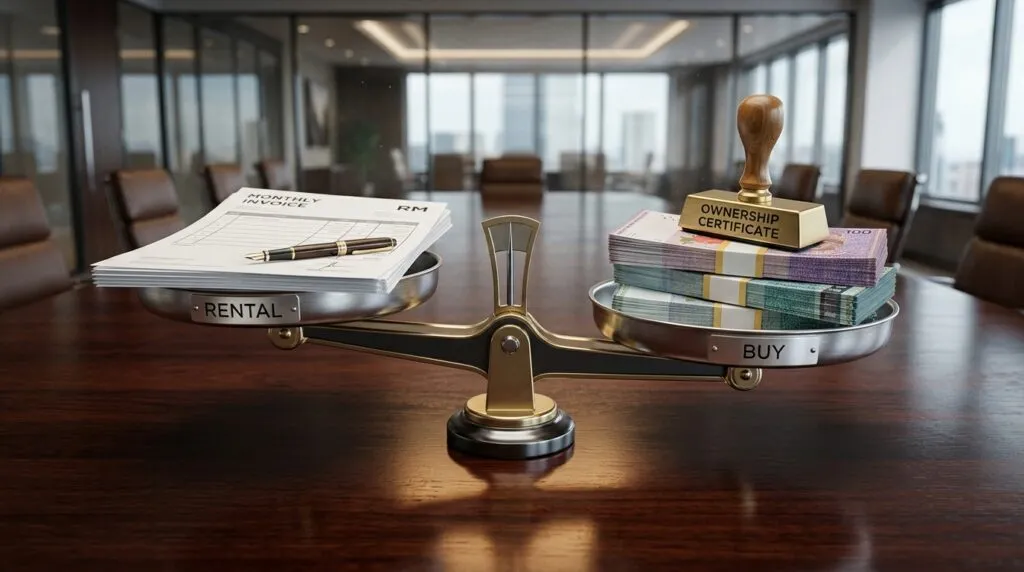
Illustrative Cost Comparison
Suppose a company requires furniture for a small office.
For illustration only, assume:
- Total furniture purchase price: RM15,000
- Hypothetical monthly furniture rental: RM450
- Comparison period: 36 months
| Cost Component | Buying | Renting |
| Initial furniture cost | RM15,000 | RM0 assumed |
| Monthly rental | RM0 | RM450 |
| Total over 12 months | RM15,000 | RM5,400 |
| Total over 24 months | RM15,000 | RM10,800 |
| Total over 36 months | RM15,000 | RM16,200 |
| Ownership after 36 months | Yes | Subject to contract |
Important: These are hypothetical figures for educational purposes, not RENTL’s actual prices or quotation. The illustration excludes deposits, financing costs, maintenance, delivery, taxes, residual value, and other contractual charges.
In this example, the cumulative rental payments exceed the purchase price during the third year.
However, this does not automatically mean buying is the better choice.
The company must also consider the value of retaining cash during the first three years, any financing costs, maintenance expenses, and the furniture’s remaining value.
A more complete comparison should include:
Total purchase cost = Purchase price + Financing costs + Maintenance + Storage/disposal costs − Estimated resale value
Total rental cost = Rental payments + Deposits or fees not refunded + Additional contractual charges − Any applicable contractual credits
For an accurate comparison, use actual supplier quotations and the same evaluation period for both options.
4. Business Flexibility: What Happens When Your Office Needs Change?
Business requirements rarely remain unchanged.
A company may expand its workforce, relocate to another office, reorganise departments, or adopt new working arrangements.
These changes can affect the type and quantity of furniture required.
When a business owns its furniture, it has direct control over how those assets are used. However, surplus furniture may need to be stored, sold, or disposed of.
With leasing, businesses can discuss arrangements that correspond to their anticipated usage period.
The ability to add, replace, return, or upgrade furniture will depend on the contract.
For businesses expecting substantial changes in their workspace requirements, reviewing these provisions before committing can be particularly valuable.
Key consideration: Buying offers ownership and control. Renting may provide useful planning flexibility where the agreement supports changing requirements.
5. Maintenance, Replacement and Furniture Lifespan
Office furniture is generally used over several years, but its useful lifespan depends on quality, frequency of use, and working conditions.
Office chairs may develop mechanical issues, desk surfaces may deteriorate, and furniture can become unsuitable as workplace requirements evolve.
Businesses that purchase furniture are generally responsible for managing these issues.
With rental arrangements, maintenance responsibilities vary according to the agreed terms.
Some agreements may include selected servicing or replacement provisions, while others may exclude damage, misuse, or particular types of repairs.
Before comparing quotations, businesses should clarify:
- Who is responsible for repairs?
- What happens if furniture becomes damaged?
- Are replacement items available?
- Are there additional servicing charges?
- What are the return conditions at contract maturity?
Understanding these responsibilities helps businesses compare the true cost of both options.
6. Tax and Accounting Considerations for Malaysian Businesses
Tax and accounting treatment can also influence a company’s decision.
Purchased furniture may qualify for applicable capital allowance treatment, subject to Malaysian tax rules and the nature of the assets.
Rental payments may also have tax implications depending on the contractual arrangement and applicable requirements.
From an accounting perspective, certain leases may require recognition of right-of-use assets and lease liabilities under relevant financial reporting standards. The treatment depends on the reporting framework, contract terms, and applicable exemptions.
Therefore, businesses should not assume that every rental payment is automatically fully deductible or that every lease can simply be classified as an operating expense.
Consult a qualified accountant or tax adviser when assessing the financial implications of either option.
7. When Should Your Business Rent Office Furniture?
Renting may be worth considering when your organisation:
Is establishing a new office
A new business may prefer to preserve its initial capital for operational expenses while spreading furniture costs over time.
Is expanding its workforce
Growing businesses may need additional desks, chairs, and workstations while managing multiple expansion-related expenses.
Requires furniture for a defined period
Project offices and other time-limited workplace requirements may benefit from arrangements aligned with their anticipated duration.
Prioritises cash flow management
A scheduled payment structure may be preferable when the business wants to avoid a large initial purchase.
Wants to evaluate leasing alongside other equipment needs
Businesses may consider furniture rental together with work PCs, printers, communication systems, and other workplace equipment.
8. When Is Buying Office Furniture the Better Choice?
Purchasing may be more appropriate when a business:
- Has stable, long-term office requirements
- Has sufficient capital available without affecting operational liquidity
- Intends to use the same furniture for many years
- Requires highly customised or permanently installed furniture
- Prefers complete ownership and control
- Determines that the total ownership cost is lower over its expected usage period
For businesses with predictable requirements and long furniture replacement cycles, purchasing can provide stronger long-term financial value.
The decision should reflect actual operational needs rather than a preference for one payment method.
9. Five Questions to Ask Before Making Your Decision
Before requesting a furniture quotation, consider these five questions.
1. How long will we need the furniture?
The expected usage period is essential for comparing total rental payments with ownership costs.
2. How much capital can we allocate upfront?
Assess whether purchasing would affect working capital or other business priorities.
3. Are our office requirements likely to change?
Consider potential workforce growth, relocation, and workspace reconfiguration.
4. What costs are included in the quotation?
Review delivery, installation, maintenance, deposits, contract conditions, and end-of-term obligations.
5. Which arrangement offers better value over our planning period?
Compare the full financial implications of both options rather than focusing only on the initial payment or monthly rate.
Explore Office Furniture Rental Solutions with RENTL
RENTL by Nazarul Corporation (M) Sdn Bhd provides business equipment rental and leasing solutions designed to help organisations manage their workplace requirements.
Through its office furniture category, RENTL offers businesses an alternative to outright purchasing, allowing them to explore leasing arrangements that align with their budget and operational needs.
Businesses can also enquire about other workplace equipment categories, including multi-function printers, work PCs, communication systems, and IT equipment.
Whether your organisation is establishing a new office, expanding its workforce, or reviewing existing furniture arrangements, RENTL can help you explore suitable rental options.
Conclusion: Should You Rent or Buy Office Furniture in Malaysia?
The decision between renting and buying office furniture should be based on more than the purchase price or monthly rental amount.
Renting may be more suitable for businesses prioritising cash flow, lower upfront investment, and defined equipment usage periods.
Buying may offer better long-term value for organisations with stable requirements, sufficient capital, and plans to retain their furniture for many years.
The best approach is to compare the total cost, operational requirements, and financial implications of both options before making a commitment.
Planning Your Next Office Setup?
Explore RENTL’s office furniture rental solutions and discuss your workplace requirements with our team.